Saturday, January 29, 2011

New Life

Sometimes, there are moments in your life which you know will be remembered for the rest of your life. Weddings, the birth of a child, graduating from college. These things are the milestones by which we gauge the passage of time. I recently had one of these experiences, when on an otherwise nondescript evening at the end of an otherwise nondescript day, I held between my fingers a tiny reminder that God loves us and wants us to be happy, that spring and new life are coming. Yes, loyal readers, the avocado tree has a flower bud. You can see the difference between the leaf bud and the flower bud, which is white and has a bulbous head. If things go well, this will eventually turn into 'El Oro Verde'.


Monday, January 10, 2011

arbor vitae

Hello Blog Readers...

It's been a while since I made a post, and I've been quite busy with the holidays, visiting family and friends, and with several garden projects.

We've been enjoying a steady influx of delicious carrots over the past few weeks, just in time for visitors to come and share in the bounty! What luck! I've also been harvesting lettuce, spinach, arugula, kale, mustard greens and radishes. Although Sarah is not a fan of radish, it is nice to have the added variety in the winter salad. But, I have to admit, they have a tendency to give me smelly burps. The goats and chickens love the carrot and radish tops, as well as the leaves from the rape (actual name of the plants from which we get canola oil...it's basically kale...and unfortunately named) that I planted in the fall as a forage crop.

A sampling of this week's harvest:


The goats' lives have gotten a bit more exciting lately as I have started feeding them on their milking stanchion, in the hopes of training them to it. They are amazingly fast learners. It took just two feedings before I could just open the gate and let Mabel run out, with PJ waiting more or less patiently for her turn. Mabel will run over to the stanchion and start eating. I can then lock her head in place and brush her, rub her belly, etc while she eats. When she's done I put her on a lead and take her back to the pen. I let PJ out and put Mabel in, while PJ runs over to eat her share. It's a great system because I can monitor how much food each goat eats, and add things like sunflower seeds or oats if I think they need it. Mabel has dandruff, which the Internet has informed me can be remedied by feeding sunflower seeds. So far so good. Incidentally, we found out today that both goats are pregnant. Very exciting.

Here is Mabel on the stand.


In addition to the aforementioned harvest, there are onions, garlic, leeks, beets, chard, brussels sprouts, turnips, peas, artichokes, california poppy, calendula, and OUR NEW FRUIT TREES!!!
Yay! We bought a Gala Apple, Granny Smith Apple and a peach tree, three more blackberries (total 5) and a grape vine. So, when you consider that we already have a fig, pomegranate and three mandarin trees, our backyard orchard is really expanding. The alfalfa planting is still quite tiny, and I turned under a bed of 'pasture' mix to plant more carrots and beets in the garden. The older flax planting is about to bloom, kind of nice for the bees on those randomly warm January days.

Here are some spinach babies coming up between onion babies. Lots of babies.


The chickens are still laying pretty well, though production has decreased from 6 per day to 4 or 5 per day (from 6 chickens). That's actually really good for January. In fact, I am hoping they will stop and molt soon so that they can be in peak form come spring. They need a break from laying to recover from the demands of creating eggs.


Oh, and, I built a grape arbor. yeah, it's pretty cool.


Here's what I did:
1) cut down a bunch of juniper trees from the wooded area near my neighborhood
2) haul them back on my shoulders
3)strip the bark with a machete
4) set the four posts in concrete footings around the porch
5) put all the top parts on
6) take some advil

All in all, it represents a lot of work, and a lot of fun.
I have planted a 'Black Spanish' grape at the corner. Black Spanish is a native grape used for fresh eating, wine making and preserves. Being a native, it is resistant to many diseases, but it is much more palatable than that other native, the mustang grape.

all for now,
g

Sunday, November 7, 2010

We're going to have a kid (or maybe up to 8 kids)!

I was actually quite nervous to introduce a buck to our sweet little does. PJ and Mabel are, of course, our pets, and though he seemed sweet enough, I had fears of incorporating this large, smelly, head-butting, big-horned creature into our herd. Especially for the reasons we intended.

Mabel has wanted nothing to do with him this past week, running up on top of the roof of her little house whenever he comes too near. But this morning, things changed. In addition to going at it a few times, Mabel and Eli have spent much of the morning nuzzling heads, while Eli "sings" a quiet, high-pitched noise and Mabel flags her tail.

The gestation period for Nigerian Dwarf goats is 145 to 153 days. So in early April, we may have two to eight babies arriving. (We anticipate hoards of people wanting these little ones, so put your name on the list as soon as you can!)
(Note: That was actually half marketing gimmick/ half daydream.) Apparently, goats typically come into heat in autumn, as day length decreases and the threat of melancholy sets in. It's perfect, this master design. We don't see it as well in our warm climate - we are actually experiencing a marked increase in garden production and don't feel the lack of creation and productivity yet - but we can feel the darkness creeping up all the same. We'll plant our flower bulbs soon, and then we'll wait for spring. Like the bulbs, and other unnamed dreams, the baby goats will develop in secret and in darkness, hidden away until spring, which teaches us year after year that life wins. That if we wait in joyful hope, we'll see birth and rebirth and reclamation of dreams.

These Advent musings, I think, are premature. Here in Austin in early November, we're still experiencing the giddiness of crisp, 65-degree afternoons. And we have many overt and sometimes noisy signs that life is winning. Several of our (human) loved ones are announcing pregnancies and having babies, and we get to observe the rush of hope (and, as aunt and uncle, avoid the sleepless nights) of new life.

Here are some pictures of a quilt I just finished for one of these important babies, machine-pieced, mostly machine-quilted (but with some hand-quilting) and hand-appliqued.

-Sarah


Friday, November 5, 2010

Eli The Goat


Yum!

--------------------------------------------------------------------------------------------

Well, we have a billy goat. Err.... a 'buck' in goat parlance. Sorry goat lovers
In any case, he's pretty cool. Eli came to us from a family up near Georgetown. Eli, like our little does, is a Nigerian Dwarf goat, and has pretty blue eyes. Apparently that's quite desirable among Nigerian Dwarf goat breeders. I don't really much care personally.

Although he's been with us for a week now, he has already begun mating with one of our does, PJ. It's a sight to behold, to be sure. When the does go into heat, they make lots of noise "baa! baa! baa!" all day long and wag their tail rapidly. Honestly, this isn't so different from their normal behavior, it is just greatly increased. When Eli and PJ are feeling romantic, they make quiet chirping/burping sounds to each other and kind of nuzzle faces a few times, then Eli will paw at her with one leg. If PJ sticks around and lets him, he'll hop on top and give it a go a few times. If he's on target, and everything has worked out, PJ will sort of squat down afterward for a few moments. I know this because I saw it happen yesterday morning as I was making coffee, then twice today. So far, Mabel has not yet come in to heat, so Eli takes little interest in her.
Don't worry, no pictures of that. (We couldn't get the camera on fast enough...)

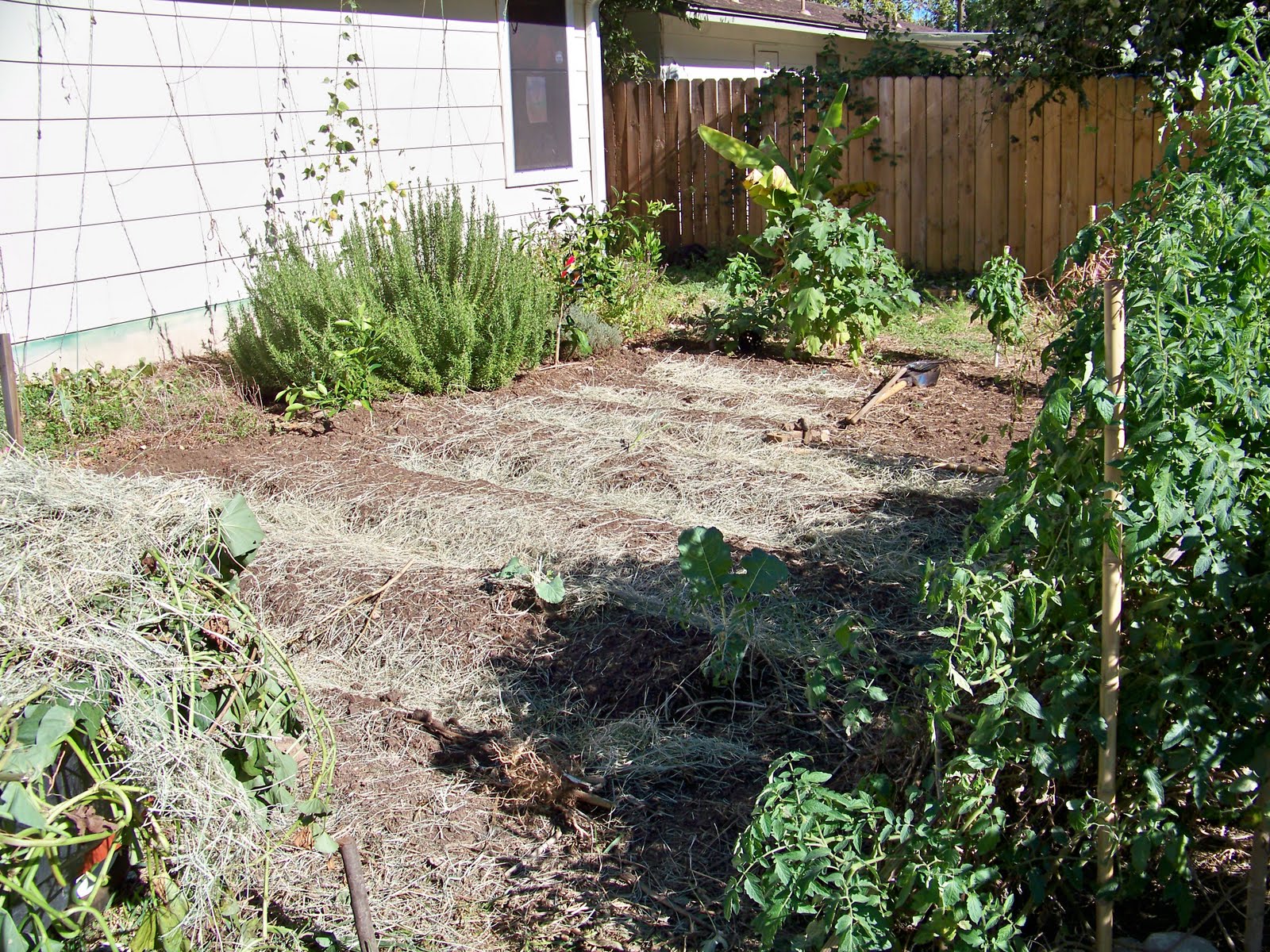
Elsewhere in the garden... I took the okra plants out. They're gone! I also harvested the sweet potatoes. So, in the space where those two venerable summer crops were, I have planted: spinach, turnips, peas, garlic, radish, chard and arugula. Here are some pictures...

And, finally, just for fun, here is a picture of me that Sarah took before Halloween. I grew a mustache for my Halloween costume, and when I put on all my gardening clothes, I really looked the part...I'm not sure what that part was, though! Maybe we've been watching too much 'All Creatures Great and Small", because I spent the better part of that day talking to myself and Sarah in my best imitation of a rural Yorkshire accent.


Happy afternoon to you all.
g

Friday, October 22, 2010

Happy Anniversary Fig

Here we have it, the anniversary fig!
OK, it's a Brown Turkey fig. But, we planted it in celebration of our 2nd anniversary, so that makes it the Anniversary Fig in my book. My grandparents had a Brown Turkey fig tree at their house in Houston, and one of my best memories of childhood is climbing up into the tree when I would go visit and eating the figs out of the top branches. I felt like a monkey!
Maybe one day this little tree will be big enough that some as yet unborn child could climb up into its branches to eat figs.


Artichoke in the zinnias. I have planted four artichokes, along the side/back of the garden. Here's one of them.


Monster Eggplant!! Doesn't that look good! Eggplant is definitely the most voluptuous vegetable.

Tuesday, October 12, 2010

What We Need Is Here


Greg woke me up one day reading this poem by Wendell Berry.

The Wild Geese

Horseback on Sunday morning,
harvest over, we taste persimmon
and wild grape, sharp sweet
of summer's end. In time's maze
over the fall fields, we name names
that went west from here, names
that rest on graves. We open
a persimmon seed to find the tree
that stands in promise,
pale, in the seed's marrow.
Geese appear high over us,
pass, and the sky closes. Abandon,
as in love or sleep, holds
them to their way, clear,
in the ancient faith: what we need
is here. And we pray, not
for new earth or heaven, but to
be quiet in heart, and in eye
clear. What we need is here.


After this, ideas for the blank canvas that had been waiting for some months quickly arrived. I covered the canvas with interior latex paint I had left over from painting a wall. A few days later I glued on some fabric bird outlines I made using enlarged stencils from a borrowed beautiful book on hand printing , and then painted the fabric birds with more leftover wall paint.

PS: We have a couple of tiny persimmon trees and hope to plant grapes within the year...


PPS: The night summer left us here, two or so weeks ago, it did so suddenly, as sometimes happens, and was replaced by cirrus clouds in a gray sky, a dusk with the unmistakably autumnal quality of light, and a chilly wind. When I saw a flock of birds in the sky, enraptured as I was (enraptured as I always am this time of year) I called out to Greg to look! at the geese flying south above us. He simply and dryly informed me that they were the same grackles always squawking around and that they were bearing east. But I don't know if grackles are clear in the ancient faith, and I want to know what is.

-Sarah

Friday, October 8, 2010

Make hay when the sun shines

Hi Mom! Happy Birthday!

So, in my last post, I think I mentioned that I have been making some hay for the goats. Here are two pictures of the hay drying. Very exciting, I know. The hay is Johnson Grass, a plant described as one of the most pernicious weeds in the world. In addition to choking out nearly every other kind of plant, it has a tendency to produce lethal amounts of cyanide in its tissue. Consequently, there are a lot of warnings NOT to feed it to animals.

On the other hand, it is also one of the most nutritious forage grasses around, if you cut it when it doesn't have the cyanide. How do you know when to cut? Basically, it is very hot weather, young growth, growth after a protracted drought and crushing that are associated with elevated cyanide levels. By cutting the hay at boot stage (just before the immature seed head emerges), and drying for several days, the initial levels of cyanide or low to nill, and they dissipate as the grass dries. Actually, Johnson Grass is one of the most widely cut coarse hays in Texas, and is commonly grazed as well. You just have to know when it is safe, and when not. Thank goodness for the internet.


I wanted to give you all a sense of scale when I talk about the goats, so I took pictures of them with chickens on top of them. Really, it's just a purely practical thing...


Hybrid Vigor
Wow! Look at the difference between these two pea varieties. The big ones are 'Little Marvel', while the small ones are 'peas that I have saved from past pea plantings year after year'. You can clearly see that the 'Little Marvel' plants VASTLY outperform the tiny saved seed plants. This is a disappointment for me, as I had really hoped that my little saved pea seeds would be more vigorous. I guess I have been harboring Mendelian Delusions or something. The small peas are a much darker green... Hmm, maybe it's just the difference between a bush vs. climbing habit. Ideas????


Some more pictures...

New growth on the Avocado tree (variety 'poncho').


Finally, the poblano peppers are putting on fruit.


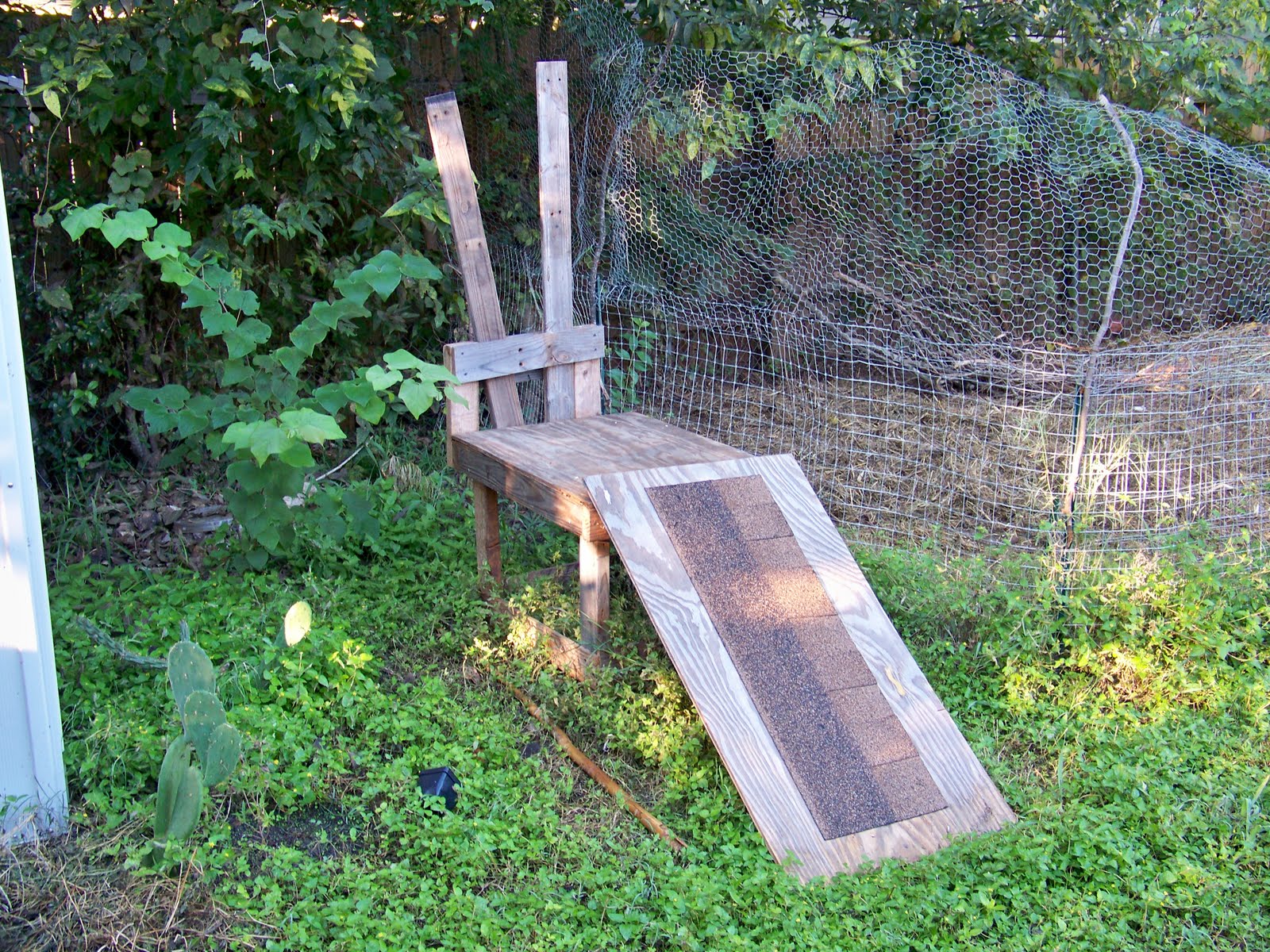
Home-made milking stanchion.


Cute chicken picture.